
Visiting Jewish Barcelona Today: A Complete Guide Of What You Can See in El Call

Updated: 4 hours ago
The Jewish community of medieval Barcelona came to an end in 1391, but its quarter did not disappear. Some of it waits in plain sight, some is underground, and some is behind doors that only open by arrangement. This guide sorts El Call by what you can actually visit, then puts it together in a route.
At a glance
Open to visitors: MUHBA El Call, the Sinagoga Major, MUHBA Domus de Sant Honorat (limited hours), and the Call Barcelona shop.
Free and outdoors: the Hebrew inscription on Carrer Marlet, Carrer Salomó ben Adret, the Roman wall and watchtower on Carrer del Call, and the tombstones in Plaça Sant Iu.
By arrangement: Casa Adret and the Cathedral archive.
What does The Call mean? Learn about it here.
Open to visitors
Open to visitors: MUHBA El Call, the Sinagoga Major, and the MUHBA Domus de Sant Honorat all preserve genuine medieval remains you can visit today, each with its own hours and quirks. Read the full visitor's guide to these sites: here
Call Barcelona. A Judaica shop in the heart of El Call, run by the Chabad community, with books, kosher products and kosher wine. A great place to stop, meet and support the local community! Visit their website.
By arrangement
Casa Adret. One of the oldest buildings in the quarter, with 12th-century foundations, the mark of the mezuzot on its doorposts, and an award-winning restoration. It is now a Jewish cultural hub, home to Mozaika and other organisations. You can enter by appointment or for an event, and all Jewish tours ends inside with an incredible visit of its 4 floors (and rooftop terrance). Read more: https://www.toldotbarcelona.com/post/what-is-casa-adret-barcelona-s-medieval-jewish-house-toldot-barcelona
The Cathedral archive. The Cathedral of Barcelona holds over 40,000 medieval parchments, hundreds of which pertain to the Jewish community of the city. In 2019, the Jewish cultural platform Mozaika began working with the Cathedral of Barcelona on Jewish-Christian interfaith initiatives. From this collaboration came the idea of creating a museum exhibit centred on manuscripts connected to Jewish life and community in Barcelona. The archive itself is closed to the public. Access is by arrangement, and it is part of our Jewish Manuscripts & Archive Tour. See what the visit is like in this article.
Free, and with no time restrictions.
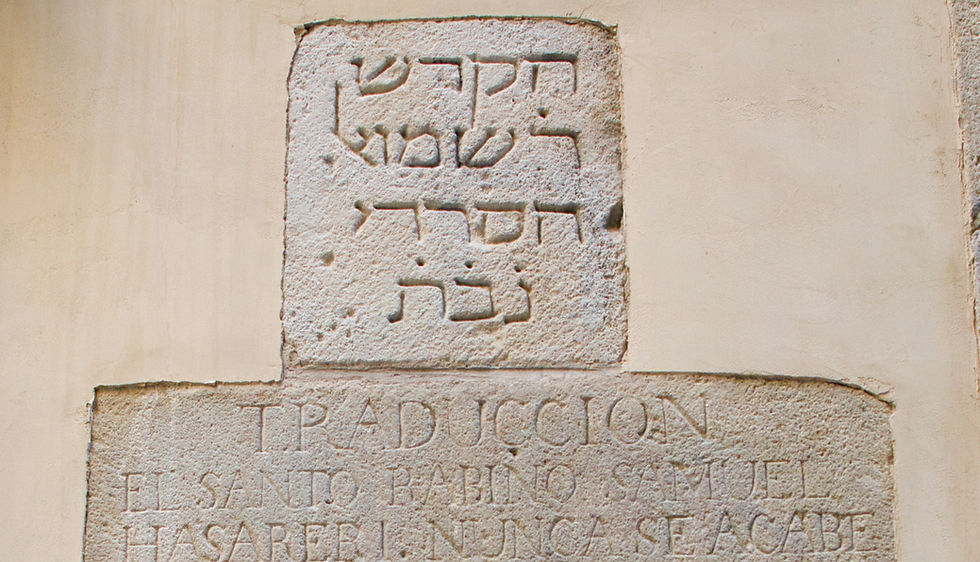
Carrer Marlet, the Hebrew inscription. Look up on the façade of the first house. It is a replica, and the original is in the city's history museum. It honours Rabbi Shemuel ha-Sardi and his charity, and it ends with a mysterious abbreviation. [Read his story]
Carrer Salomó ben Adret. Once called Carrer de la Carnisseria, the street of the butcher, this is the main street of the Call, named after the great 13th-century rabbi known as the Rashba. Until 2018 it was called Sant Domènec del Call, after the attack of 1391, and the City of Barcelona worked with local Jewish communities to rename it as an act of reparation. You can watch the unveiling here.
Carrer del Call, the Roman wall. Stand by the wall and look up to see the remains of the watchtower once linked to Castell Nou, at the spot where the attack of 1391 took place and described in Rabbi Hasday Creques accounts..
Plaça Sant Iu, the tombstones. A short walk beyond the limits of the Jewish quarter, between the Cathedral and the Royal palace, you'll find Plaça st Iu. Look up at the walls of the Palau del Lloctinent (the Lieutenant's House). Can you see any Hebrew? Some of the stones are tombstones from the Jewish cemetery on Montjuïc, reused after the attacks of 1391, and Hebrew letters are still visible centuries on. Today the building houses part of the archive of the Crown of Aragon. The old Jewish tombstones adorn some of Barcelona's most important Gothic landmarks. The stones closer to street level show clear signs of deterioration, making the letters hard to read, but they remain a clear sign of the complex history of the city.
Turn around and step through the archway, and you reach the quiet patio of the Museu Frederic Marès, once part of the same royal palace complex, and later the seat of the Spanish Inquisition in Barcelona. A worn coat of arms on the building is the only visible trace of that history today. We explore the stories of conversos, inquisitional trials and the complexities of everyday life through food on our tours.


Our recommended route through Jewish Barcelona:
Plaça Sant Jaume. The original gate of the quarter, where Carrer del Call met Carrer Sant Honorat.
Carrer Sant Honorat and Carrer de la Fruita. For the Domus de Sant Honorat and its medieval silos, though it's worth checking the day, since access is limited outside Sundays.
Carrer Salomó ben Adret. The heart of the Call, once the street of the butcher, and a good spot for tea at Salterio.
Carrer Marlet. For the Hebrew inscription and the Sinagoga Major.
Casa Adret. Worth pausing outside even without an appointment, to see the façade and sense the house's age; entering is by arrangement or as part of our Highlights Tour.
MUHBA El Call, Plaça Manuel Ribé. The museum of the quarter's medieval remains, with lunch at Bistrot Levante on the same square.
Carrer del Call. Stand by the Roman wall to see the remains of the watchtower and the site of the 1391 attack.
Plaça Sant Iu. For the reused tombstones on the Palau del Lloctinent, and the quiet patio of the Museu Frederic Marès just beyond.
Carrer Ferran. A short walk from here, outside the church built on the site of the Call Menor's synagogue.
Going deeper
Sometimes you need an expert to help make the streets come alive. To have the quarter explained, join us on the quarter explained, join us on the Jewish Quarter & Casa Adret Highlights Tour or the 4-hour Rumours, Secrets & Legends tour.


Comments