
Shemuel ha-Sardi: Law, Charity and Controversy in 13th-Century Barcelona

Updated: 6 days ago
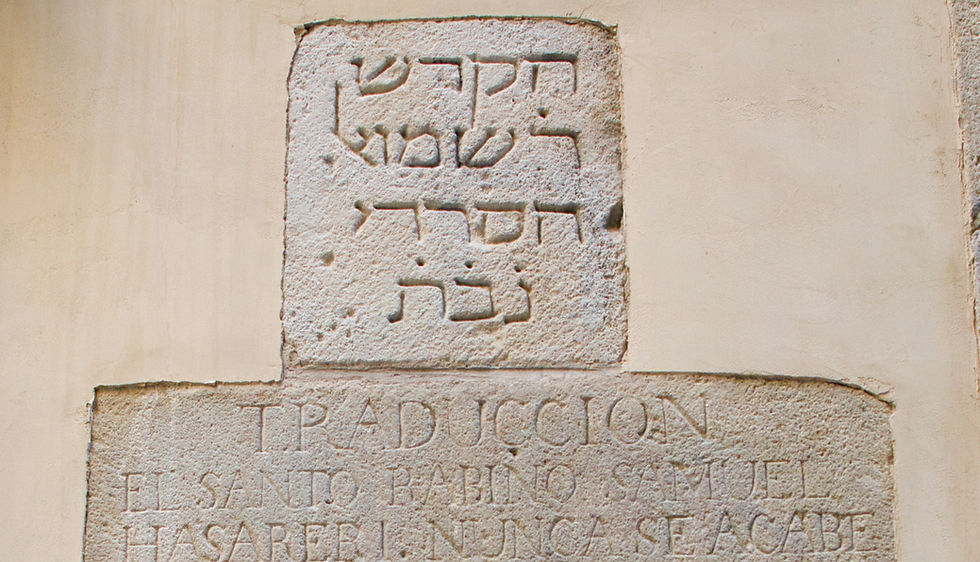
On Carrer Marlet, in the heart of El Call, a Hebrew inscription marks the place where, more than 700 years ago, one man's generosity was commemorated. What you see today is a replica; the original stone is preserved in the city's history museum.
Look closely at the end of the inscription and you will notice three Hebrew letters that are an abbreviation. The city's museum panel reads them as a line from Proverbs 11:25, "he who is generous thrives, he who refreshes others, will be refreshed". A fitting verse for a man remembered for his generosity, though the panel admits that expanding the three letters leaves room for doubt, and other readings, such as "may he remain joyful" or "may his soul rest…", are also possible. Even in stone, keeping a little mystery.
That man was Shemuel ha-Sardi: rabbi, legal scholar and philanthropist. His Sefer ha-Terumot, written in 1225, is a landmark work on Jewish civil and commercial law that shaped halachic scholarship for generations. And he used his wealth to found a charitable institution, a Heqdesh, for the Jewish community of Barcelona, an enduring example of compassion and communal responsibility. Even his name holds a small mystery. For many years, scholars misread his surname as Hasarari. Later studies confirmed the correct reading, ha-Sardi, "the Sardinian", pointing to family origins on the island of Sardinia.
Shemuel lived in a Barcelona that was wealthy, ambitious and far from calm. Early in the 13th century, the community went through episodes of internal conflict, and in 1241 James I gave it a constitution, to be run by administrators drawn from among its wealthy members. Who should lead, and on what terms, was a live question.
The intellectual world was just as restless. Shemuel was a contemporary of Nahmanides, whom he consulted on questions of Talmudic law, and he lived through the great controversy over the works of Maimonides. Historians see it less as a debate about Maimonides himself than as a clash between Jewish communities living under very different cultural and political conditions. Solomon ben Abraham of Montpellier, one of Maimonides' fiercest critics, wrote to rabbis across France and Spain, including a letter to Shemuel that recalled their friendship in youth. In Barcelona itself, the translator Abraham Hasdai was a passionate champion of Maimonides. These were not distant arguments.
Only a few decades later, in 1263, Nahmanides would face Pablo Christiani in the famous Disputation of Barcelona, in the presence of James I. Then we see the scale tipping, as we enter a new chapter for the community...
Not every voice from this world belonged to a rabbi. Shemuel's widow, Caròssia, left her own mark on the record. A document preserved in the archive of Barcelona Cathedral shows a woman who refused to be overlooked. It is one of the stories we tell on our Jewish heritage tours. The rest we keep to the archive itself.


Comments